


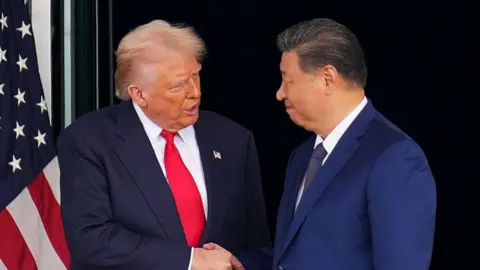
American leader visits overseas have typically been an occasion to showcase the power of the US on the world stage. Donald Trump's week-long swing through Asian nations, conversely, has been a display of the authority of the president – but also, at times, of that authority's boundaries.
The president's destinations in Malaysia, Japan and Korea over the course of the first four days were an exercise in catering to a occasionally unpredictable American president. It was an admission that Trump, with the signature of a hand, could introduce taxes and additional actions that have the potential to damage the financial systems of export-dependent countries.
His discussion with Beijing's head Xi Jinping on the final day, nevertheless, was a distinct situation.
It was a session of counterparts on the global stage, where the stakes for each country – for their financial health, for their world reputation, for the well-being of their people – were significant.
With the Chinese, Trump may wave his authority, but these moves come with ramifications. They involve a toll.
- The US president hails 'impressive' talks with Xi but no trade deal reached
- Xi and Trump establish temporary truce as China pursues extended strategy
For the opening segment, Trump's recent entry into international relations was uneventful.
Each visit was characterized by a blend of traditional commercial discussions – arrangements made under the threat of Trump's "reciprocal" tariffs – and individual concessions that at times bordered on the deferential.
In the Malaysian stop, the president obtained access to critical minerals and made advances toward concluding trade arrangements with ASEAN countries. He also oversaw a treaty that should alleviate frontier issues between Thailand and Cambodia – the type of "peace deal" the president prefers to tout.
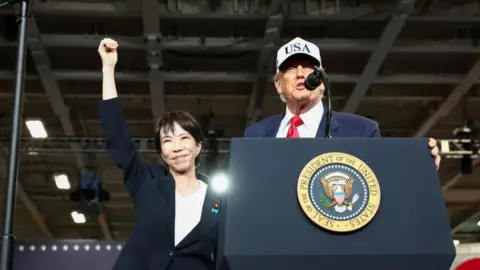
In the Japanese leg, Trump's helicopter flew past a famous structure lit US flag colors – with a summit in Trumpian gold.
Freshly appointed Leader the Japanese leader detailed $550bn in Japan's financial commitments in the United States and offered the president a gift of 250 cherry trees for America's 250th anniversary, and a sports gear and carrier that belonged to the late leader, the murdered ex-leader who bonded with Trump in his initial presidency.
She also became the most recent foreign leader to propose the president for his long-sought international honor.
Keeping pace, the Korean government received Trump with cannons firing a 21-gun salute and a military band that played the leader's song and the classic tune – the band tune that has become a presidential event theme.
Leader the Korean president held an "recognition ritual" for the US leader during which he awarded the US president his country's highest medal and a replica of an ancient Korean dynastic crown.
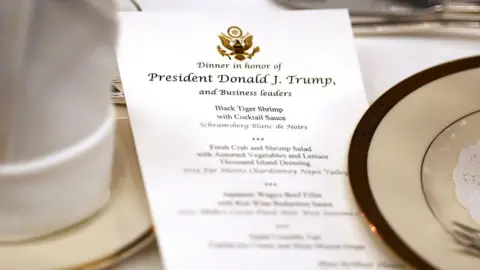
Lunch with the Korean leader included a "Conciliatory Treat" of gilded brownies. Afterward, the hosts offered Trump vineyard wine at an exclusive gathering in the president's honor with half-dozen world leaders present at the Asia-Pacific Economic Conference meeting.
In the America, Trump may be the target of "No Kings" demonstrations by US citizens who disapprove of his limit-pushing extensions of executive authority, but during his regional visit he was handled as nobility.
And like the monarchs of old, the president visited the Korean nation demanding payment – in the shape of $200 billion in financial transfers, $20 billion a per year, from Korea to the America, to be invested at the direction of the president's government. Agreement on the conditions of those transfers contributed to that the tariff rate on South Korean exports to the America would decrease from 25% to fifteen percent.
The main event of Trump's Asia trip came in its last moments, though, as he sat down with the Chinese leader.
In that setting, the power dynamic between counterparts of the global top two markets was markedly distinct than the interactions the president had with his foreign counterparts in prior visits.
Not present were all the ceremony and the spectacle. Without any armed forces orchestras, no ceremonial troops, no meticulously designed menus celebrating bilateral friendship. By contrast, the both heads and their key staff were seated across a extended light-colored discussion surface in a nondescript military building just adjacent to the landing strip of the city of Busan's international airport.
It was perhaps a indication of the major consequences that when Trump made contact with Xi in Busan, he appeared

